
Regional reciprocity measures the alignment of visa regimes by Member States of a REC. High levels of reciprocity mean there is a high degree of alignment in how Member States apply visa policies to each other, on a reciprocal basis. Every Member State’s policy with respect to every other Member State of the REC is counted, and policy alignment is achieved whenever the same policies are mutually in place by two countries. The focus here is therefore on intra-regional consistency rather than measuring visa openness per se, with a high score indicating alignment, and a low score misalignment.
AVOI focuses on a key aspect of reciprocity, namely how members of a REC extend visa-free privileges to one another on a reciprocal basis and have in this way established ‘positive reciprocity’. A high score in the visa-free reciprocity metric suggests a high degree of harmonisation of visa-free policies within a REC. This then implies that countries are generally open to arrivals of each other’s nationals and permit easy access, without the need for a visa. High scores tend to be due to well-established regional protocols relating to the movement of persons, along with high levels of implementation, but may also be driven by countries’ understanding of the economic and social benefits that may follow from such policies. Since regions with high visa-free reciprocity scores also tend to be well integrated economically, they often thrive in other developmental indicators too.
On the other hand, low visa-free reciprocity scores suggest that a region has not fully implemented wider initiatives to ease the movement of the region’s citizens across its national borders, and that countries that are more open towards the citizens of neighbouring countries do so based on their national interests. At other times, notwithstanding a regional protocol, specific issues between neighbours, or a country’s internal issues and processes, can result in poor or delayed implementation. This affects regional reciprocity openness scores while perpetuating barriers to the movement of persons.
Visa-free reciprocity at a continental level has shown a small improvement during 2025, from 20.3% to 20.5%. This can be construed as an indicator of higher levels of visa-free policy alignment and some progress on regional initiatives to free the movement of persons. Closer scrutiny of the visa policies of all Africa’s countries, particularly within AU RECs, suggests that a relatively small number of mostly unilateral, national policy changes have driven this year’s slightly higher visa-free reciprocity score. In a select number of cases, individual countries’ imposition of visa formalities ahead of travel has been reciprocated by countries whose citizens have been affected by such a move, which has reduced the magnitude of improvements in visa-free reciprocity.
There has, however, been a significant increase in the number of travel scenarios where countries now impose a visa on a reciprocal basis, thus aligning their restrictive policies. This visa-required policy alignment has increased from 27.9% in 2024 to 33.2% in 2025.
In contrast, in 41.4% of all scenarios, visa policies remain misaligned. This suggests many untapped opportunities for enhanced visa openness performance, where countries could align their own visa policies at a bilateral or regional level to the more liberal policies that other countries offer their citizens in return. Such incremental steps would have a significant overall positive impact on visa openness. Countries that are still reluctant to make major reforms can target bilateral changes as a priority.
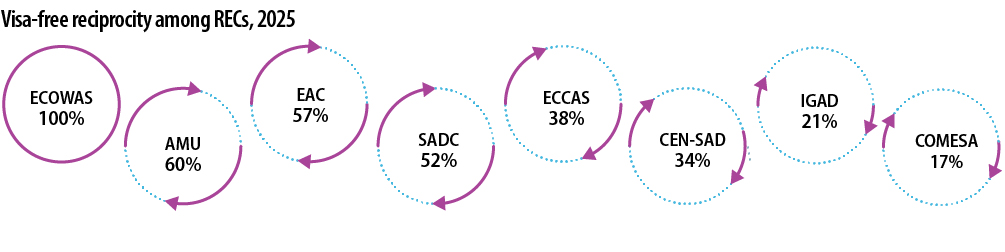
Overall, visa-free reciprocity across Africa has inched upwards slightly over 2025. There have, however, been several incremental changes within some RECs
ECOWAS (100%) becomes the first region to apply visa-free access on a fully reciprocal basis, after Guinea-Bissau lifted visa formalities on citizens of São Tomé and Príncipe (2024: 99%).
AMU (60%) has declined in its visa-free reciprocity score (2024: 70%) yet still maintains the second highest level among the RECs. As the smallest REC in terms of number of Member States, individual changes have a significant impact on the score. In this instance, the only change relates to Algeria implementing a visa requirement towards citizens of Morocco.
EAC (57%) moves to third position with respect to visa-free reciprocity, after Tanzania provided citizens of DRC with visa-free access. Kenya had, in 2024, already waived ETA requirements towards most EAC Member States, meaning its latest policy change does not affect the intra-regional score significantly.
SADC (52%) scores lower than it did in 2024 (60%) after considering the impact of Seychelles' ETA, while an expansion of visa-free access by Mozambique and Zambia towards several other SADC States has yet to be reciprocated.
ECCAS (38%) shows a significant improvement over last year (2024: 33%), due mainly to visa-free changes implemented by Equatorial Guinea.
CEN-SAD’s (34%) regional visa-free reciprocity remains unchanged from last year.
IGAD (21%) achieves a significant increase in its visa-free reciprocity metric this year (2024: 14%), driven entirely by Kenya’s updated visa-free policies. However, visa-free reciprocity remains at a low level, ahead only of COMESA.
COMESA (17%), with an unchanged score over 2024, is now the lowest ranked REC in terms of Member States extending visa-free privileges to each other on a reciprocal basis.