
e-Visas are digital equivalents of paper-based visas, but are obtained electronically through an online platform, thereby negating the need to visit or send a passport to consular offices.
As of 2025, 31 African countries adopted e-Visa systems, an increase from 26 reported in 2024. New e-Visa platforms were noted for Djibouti, Equatorial Guinea, Mauritania, Namibia, and Somalia.
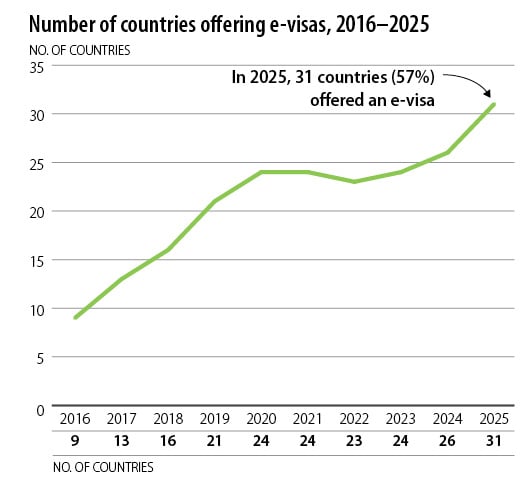
e-Visas are important and potentially powerful aspects of a country’s digital strategy and immigration modernisation process, serving as a convenient way to manage inbound travel, expand global reach, obtain cost efficiencies (by reducing the overhead on consular staff) and capture electronically relevant data of prospective travellers. e-Visas hold several distinct advantages over paper-based traditional visas, as reflected on below:
Key benefits of an e-Visa are:
- Convenience: A faster and simpler process through which the applicant applies electronically from the comfort of their home or office.
- Lower cost: Travellers experience lower costs and administrative overheads because they do not need to apply in-person. For governments, e-Visas mean automated screening, fewer walk-ins, and the use of fewer resources, especially by its consular services.
- Better accessibility and transparency: The ability to obtain a visa electronically is an attractive proposition for prospective travellers, especially compared to paper-based processes and their associated logistics. This, in turn, may contribute to higher visitor numbers. e-Visa portals lend themselves to greater transparency by providing relevant and complete information (documentation, eligibility, costs) to the applicant.
e-Visas also have several drawbacks, which are important considerations for travellers and governments.
- Digital barriers: e-Visa applications, by default, require access to digital infrastructure - computers or mobile devices, and a stable internet connection, alongside the ability to furnish relevant documents in digital format.
- Risk of fraud: Given the plethora of private visa facilitation services, and sometimes weakly designed official government portals, there is a risk of applicants using incorrect or scam websites that mimic official platforms and unintentionally share data with third parties which can be used for illegal means.
- Limited applicability: Some e-Visas limit the traveller to entry through main airports, rather than land borders.
- Systems issues: During preparation of this and previous AVOI reports, instances of offline and malfunctioning e-Visa portals were observed, or portals with unencrypted web connections or coding vulnerabilities. A weakly designed e-Visa portal has data privacy concerns and potentially exposes payment information to risk. Governments that implement an e-Visa have a responsibility to ensure data integrity and security, consistent uptime, efficient processing and upfront transparency around information requirements and visa eligibility.
- Similar obligations: Both e-Visas and traditional paper–based visas may impose broadly similar obligations on the applicant, which may include a digital copy of a passport, a head and shoulders photograph, and potentially various other pieces of information such as copies of bank statements to prove financial means, health insurance, return air ticket, hotel or accommodation details, and so forth. Payment typically involves the input of credit or debit card details in a payment portal linked to the e-Visa platform. A visa may then be issued in electronic form, by way of a confirmation letter in PDF format, a QR code, or in another format. Sometimes, the e-Visa process will require the applicant to collect an e-Visa passport sticker on arrival at the destination country, creating additional inconvenience.