
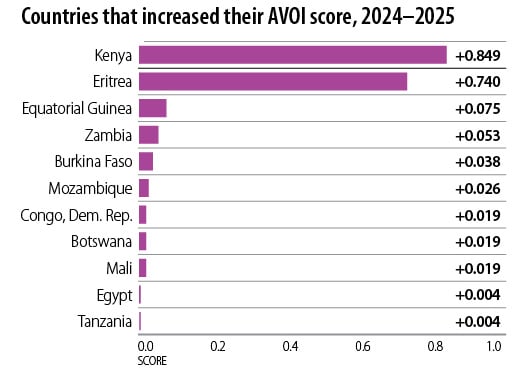
Although the 2025 average AVOI score [0.445] across all African countries is lower than that of the previous three years (2022 – 2024), and only marginally higher than in 2021 [0.444], some countries made notable policy changes to ease cross-border travel in 2025, while others fell in the rankings as new visa policies came into force, even if in the context of introducing e-Visa systems. Below, we shine the spotlight on a few.
Kenya
Kenya has made large strides towards visa openness over the past year, shifting towards a visa-free regime for African travellers. In 2024, when waiving visa requirements from most African countries, it implemented an ETA. For many previously visa-exempt countries on the continent, this represented a significant additional administrative burden and cost, de facto resulting in a requirement for an e-Visa prior to travel. Initially only some EAC Member States were exempt from the ETA process. But now, Kenya has exempted African citizens more broadly from the requirement of a visa, and also of an ETA. Only citizens of Libya and Somalia still require an ETA to travel to Kenya.
With this latest development, Kenya has set an important marker on easing movement of persons, reinforcing its leading role as a hub that connects inland populations with Kenya’s cities, transport routes and seaports. Following the country’s downgrade on the AVOI in 2024 in response to its ETA processes which were categorised as an e-Visa, Kenya now attains its highest ever rating, coming in third, behind Rwanda and The Gambia which share joint first place.
This policy change is significant because Kenya’s economy and location make it a key driver of regional integration. As a member of COMESA and EAC, Kenya plays a central role in facilitating trade, investment and the movement of people in the region, providing port facilities for trade to and from landlocked countries like Burundi, Democratic Republic of Congo (DRC), Rwanda, South Sudan and Uganda. Kenya has expanded the number of One-Stop Border Posts to reduce processing times for cross-border traders, which is an efficiency enabler for enhanced regional trade.
Zambia
In January 2025, Zambia abolished the requirement for a visa from citizens of 53 countries globally - a move aimed at enhancing the country’s status as a tourism, business, trade and investment destination1. This increases visa-free access to citizens of 167 countries, including an additional six African countries - Cabo Verde, Comoros, Madagascar, São Tomé and Príncipe, Liberia and Morocco, the latter two of which previously required a visa ahead of travel to Zambia. This also raised the country’s AVOI rank from 24th to 19th with 20 African countries now granted visa-free access, while citizens of seven countries can obtain a visa on arrival, and 26 remain subject to a visa ahead of travel, available through the country’s e-Visa portal.
Within SADC, Zambia already maintains one of the most open visa regimes, with visa-free entry now available to citizens of all but one country (DRC), which is still subject to a visa on arrival. Zambia has made significant strides in promoting inbound tourism through its ‘Destination Zambia’ campaign, and is prioritising air connectivity within the country especially to a broader range of heritage and wildlife destinations, and implementing road infrastructure improvements to support expansion of tourism access and economic development. Inbound tourism has increased to record levels, rising by 35% in 20242.
Guinea Bissau, Mauritania, Nigeria and Somalia
These four countries switched to a visa required ahead of travel in 2025, from previously offering visa-on-arrival facilities to citizens of most African countries. This translates into a collective impact on 162 travel scenarios where citizens of African countries are now required to obtain a visa ahead of travel, and has resulted in the four countries’ placing in the lower half of the index. However, it is important to point out that three of the four countries - Mauritania, Nigeria, and Somalia - offer e-Visas to prospective travellers. In fact, Mauritania and Somalia have newly developed e-Visa portals. While e-Visas invariably entail obtaining a visa ahead of travel, curtailing freedom of movement, they can be a potentially important stepping stone in countries’ evolution towards enhanced openness, while also addressing possible security concerns.
Seychelles
Seychelles has in the past ranked at the top of the AVOI. As an Island State, patterns of travel to and from Seychelles differ from those involving countries on the continent, with arrivals either by air or by sea. The country largely digitalized its border management processes through the Seychelles Electronic Border System3, and was the first African country to implement a fully-fledged ETA system applicable to all incoming travellers, having recently expanded to include maritime arrivals. All prospective travellers to Seychelles who are non-citizens are required to apply for an ETA ahead of travel, as per the country’s Immigration Act.
To obtain an ETA, applicants must provide passport details, contact information, a "selfie", as well as trip information (a confirmed airline or cruise ticket with arrival and departure dates, accommodation booking confirmation for each location of one’s stay in Seychelles, as well as a letter of invitation if visiting friends or family). There is a cost involved, which requires the use of a credit or debit card. Since the ETA requirements substantively overlap with other countries’ e-Visa systems, and IATA likewise indicates this as a pre-travel requirement at the time of boarding, the AVOI classifies the ETA in the same way that it classifies an e-Visa, which is considered a visa-ahead-of-travel, and informs Seychelles’ updated ranking on the AVOI. Readers will recall that Kenya’s ETA was similarly categorised as equivalent to an e-Visa in last year’s report, which at the time saw it ranked 46th on the index4.
4 Also note discussion on ETAs in this year’s report