
Progress since 2016 can be tracked through three key metrics. The first metric tracks changes in the number of country-to-country travel scenarios where no visa is required. This has reached an all-time high (814 country-to-country connections are now visa-free), slightly improved from last year (803).
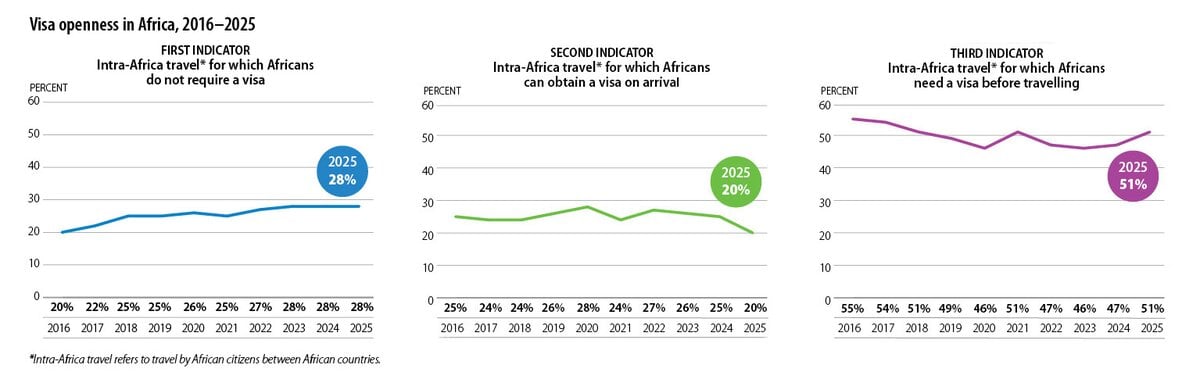
The second metric reveals the number of travel scenarios where a visa can be obtained on arrival at the destination country. Unlike the other two metrics, a change here does not necessarily reflect a positive or negative development outright, as it depends on what policy preceded a switch to offering visa-on-arrival facilities. For example, an increase in visa-on-arrival travel scenarios can mean that travellers from previously visa-free countries are now subject to a visa (a regressive change, and the percentage increases), while it can also mean that travellers from countries subject to a visa ahead of travel can now get a visa on arrival (a positive change, yet also leading to a percentage increase in this metric).
Conversely, as countries increase their visa-free offerings and others move from visa-required to visa-on-arrival, this may cancel out the respective percentage changes yet still represent significant progress in easing the travel experience. This year, the visa-on-arrival metric reveals a 12% drop from 711 to 585 travel scenarios where a visa is available on arrival, representing 20% of the total. Read together with the first and third metric below, this is a negative development compared to 2024, as it results from a significant net increase over the past year in visa-required travel scenarios.
The third metric measures country-to-country travel scenarios where a visa must still be obtained ahead of travel, be it through a traditional paper-based application process or an e-Visa that is obtained digitally. The key criterion here is whether the travel authorisation must be obtained before embarking on travel. While a digital online process is a significant improvement over in-person applications, the AVOI methodology does not distinguish between the different ways of obtaining a visa ahead of travel; traditional and e-Visa processes are both treated as a visa ahead of travel. But, as the section on e-Visa evolution reveals, there are now more e-Visa options than ever before, which means that the ease with which Africans can travel between countries supported by digital progress is in fact greater than is nominally indicated by this metric. In other words, a straightforward digital process is far more advantageous to a prospective traveller than obtaining a traditional, mostly paper-based visa that involves a visit to consular offices. Over the past year, the visa-required score has increased from 47% in 2024 to 51% in 2025, albeit still below its starting point of 55% in 2016. A visa or visa-equivalent ahead of travel is now required in 1,463 travel scenarios, significantly up from 1,348 in 2024. of travel is now required in 1,463 travel scenarios, significantly up from 1,348 in 2024.