
Ten years of tracking African countries’ visa policies allows for reflection on progress made since 2016. The leading metrics make for positive reading. In 28.2% of all country-to-country travel, African citizens can now visit another country without the requirement of a visa, up from only 20% in 2016. In relative terms, compared to ten years ago this translates into a 40% improvement in intra-Africa travel supported by visa-free access. But a visa is still compulsory ahead of travel in 51% of all travel scenarios, down from 55% ten years ago, though still hovering above the 50% mark. This invites introspection: While overall there has been significant progress in efforts to ease intra-Africa travel, there remains a long way to go.
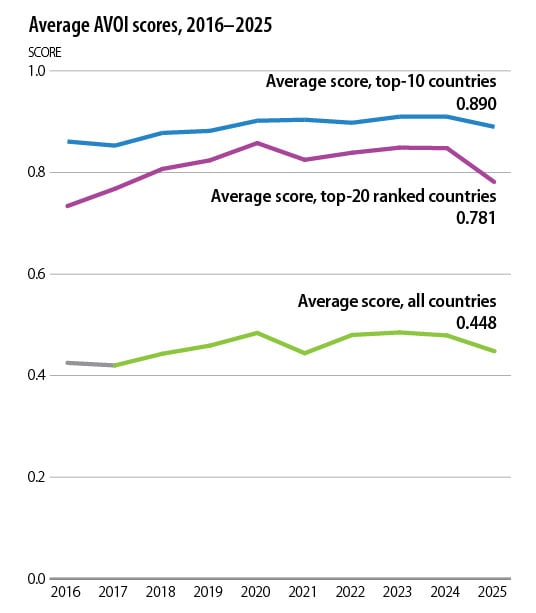
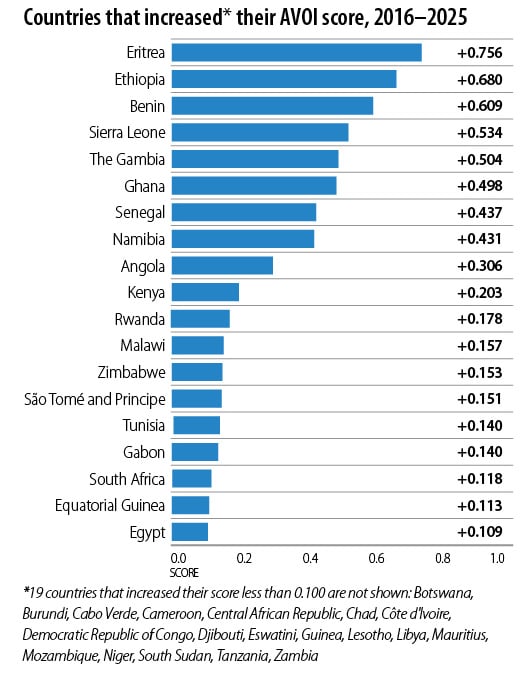
Thirty-nine countries have improved their score on the AVOI since the first report in 2016, a reflection of broad, overall progress towards easing intra-Africa travel. Yet progress has often been slow, as higher individual scores often result from only small, incremental changes, countries entering into bilateral arrangements that embed reciprocal easing of visa policies into these reforms, or involve countries embracing more liberal policies but only within the confines of a REC, sometimes supported by a regional agreement on intra-regional movement.
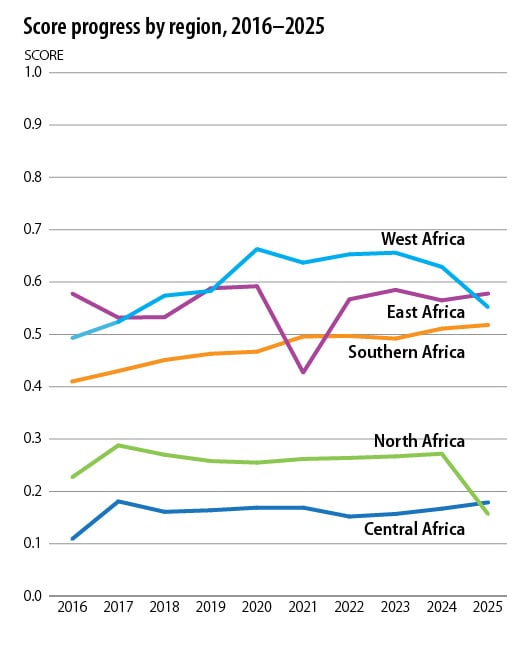
No further ratifications of the AU’s Free Movement Protocol beyond the initial four countries have followed in the past six years, suggesting that progress on visa openness has not been driven by this instrument - even if the underlying ideals of the Protocol may be more widely supported. Rather, progress is rooted in individual country policies and through collective efforts of several of Africa’s RECs. Only in a small number of instances have progressive - and no doubt bold - policies seen countries implement visa-free entry at a continental level, or have countries introduced visa-on-arrival policies that eased the travel experience when compared to traditional visa processes that were needed ahead of travel.
Over the 10-year period, Benin, Seychelles, The Gambia, and more recently Rwanda, have been trailblazers on visa openness, offering visa-free access to the rest of the continent. Benin stands out as one of the most improved countries on the AVOI, but this year dropped from joint 1st to 4th place after adding visa requirements for citizens of five African countries. Benin climbed from 31st place in the first edition, attaining top spot in 2018.
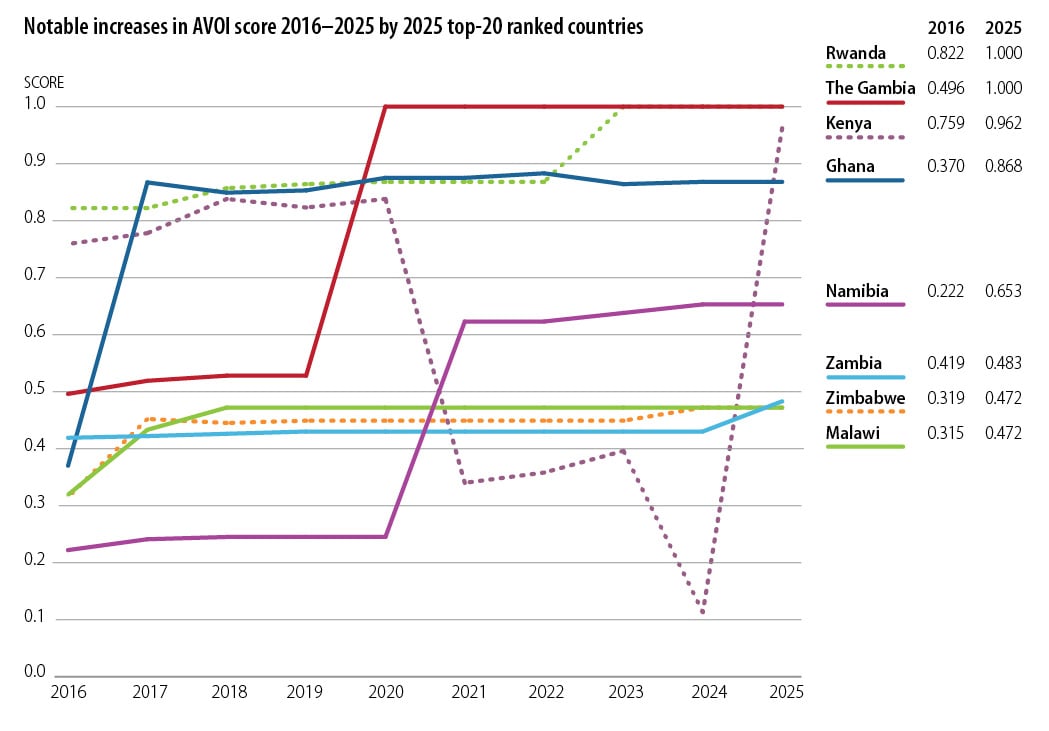
Similarly, The Gambia became visa-free to citizens of all African countries in 2020 and has retained its place at the top in subsequent years. Rwanda reached its visa-free policy milestone in 2023. And Seychelles, which had previously occupied its place at the top of the AVOI since the first report, later launched an ETA system - compulsory for all visitors and recently extended to maritime arrivals - to be obtained by prospective travellers ahead of travel. Kenya's impressive progress has been explained earlier in this report.
Several other countries have also made significant progress, even if sometimes starting from a relatively low base. Eritrea and Ethiopia are two of the most improved countries when considering the difference in overall score in 2025 versus 2016, in terms of the AVOI’s assessment methodology and scoring system. Eritrea recently introduced visa-on-arrival applicable to all countries (except citizens of Kenya and Uganda who enter visa-free), while Ethiopia now only requires a visa ahead of travel from citizens of five countries (Egypt, Eritrea, Libya, Nigeria and Sudan), with its vastly more liberal visa regime first noted in the 2019 edition (and then interrupted by a more restrictive visa-policy period during Covid-19, as reflected in the 2021 report). Several West African countries - particularly Ghana, Senegal and Sierra Leone - all now feature high on the index after making significant progress in adopting more liberal visa policies. They had, for some time, already demonstrated visa openness towards citizens of the Economic Community of West African States (ECOWAS).
More recently, progress on easing travel for African citizens has been slow and ambiguous, with positive changes often small and incremental. This year’s net increase in visa-free travel scenarios is outweighed by the significant increase in visa-required policies, and visa openness has advanced only on a more targeted, individual and sometimes bilateral basis (Kenya’s relaxation of its ETA requirements being a notable exception).