
As Africa integrates across diverse political, business, cultural and social landscapes, its Regional Economic Communities (RECs) continue to lead as enablers of the free movement of persons. For many countries, the more familiar regional environment helps encourage more liberal visa policies, but as the analysis below illustrates, this is not the case in all RECs.
The AU recognises eight RECs:
- Arab Maghreb Union (AMU)
- Common Market for Eastern and Southern Africa (COMESA)
- Community of Sahel-Saharan States (CEN‑SAD)
- East African Community (EAC)
- Economic Community of Central African States (ECCAS)
- Economic Community of West African States (ECOWAS)
- Intergovernmental Authority on Development (IGAD)
- Southern African Development Community (SADC)
Regional integration creates bigger markets by cutting intra-regional tariffs, reducing non-tariff barriers and facilitating trade through more efficient transportation routes and border formalities, including One Stop Border Post facilities. This can provide fertile ground for regional value chains to develop and flourish on the back of more efficient and integrated markets. It also drives and benefits from greater policy cohesion among Member States, can facilitate coordinated responses to external shocks and natural disasters, and encourages cooperation on joint public health initiatives.
Most RECs have adopted treaties to progressively enable their citizens to enter, establish and reside in each other’s countries. Implementation is at varying stages, with some having elevated to use of common passports, such as in East and West Africa. Where adoption has succeeded, visa openness enables high levels of regional mobility, and the mutual trust underpinning this cooperation helps to stabilize complex times when countries tighten their hitherto progressive visa policies.
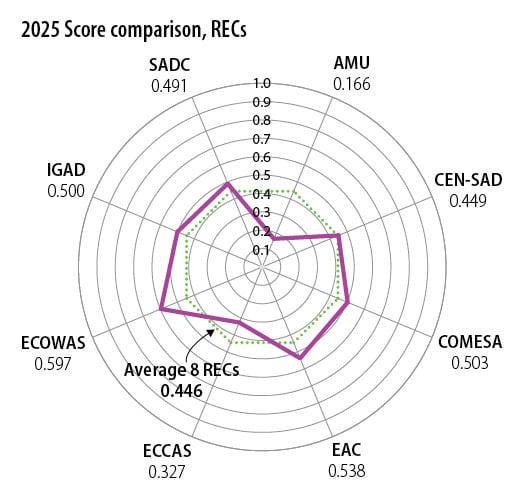
Tracking average REC scores
Tracking visa openness in the AU’s eight recognised RECs provides insights into their overall progress within the broader continental context and also reveals how RECs are faring within their own regional initiatives. For this, the AVOI measures regional visa openness in two ways:
- First, AVOI measures average visa openness, which is calculated by combining each Member State’s individual score within that REC and dividing by the number of members. This provides insights into regional attitudes towards easing the movement of people more broadly, and in this respect, offers a reflection on visa openness trends over time.
- Second, as shown in the next section, AVOI also measures regional visa reciprocity, which gauges the extent to which visa policies are reciprocated among Member States within the defined regional group. Higher levels of reciprocity suggest policy congruence, without making a finding on whether this congruence is deliberate or coincidental. High levels of visa-free reciprocity are an expected outcome where regional protocols exist and have high levels of implementation.
In 2025, four of the eight RECs achieved an average score above their 2024 score, with IGAD, EAC, ECCAS, and COMESA, in descending order, having improved the most.