
2025 marks the tenth consecutive year that the Africa Visa Openness Index (AVOI) has tracked Africa’s visa policies. This edition marks an important milestone, by offering an opportunity to shine a light on notable developments while reflecting on where progress has stagnated. Unpacking this data over the following pages allows a more nuanced assessment of where visa openness has progressed, regressed, or where technological interventions have shifted the visa application process away from the destination (visa-on-arrival) to the departure country (e-Visa / Electronic Travel Authorisation - ETA) - which impacts a country’s score.
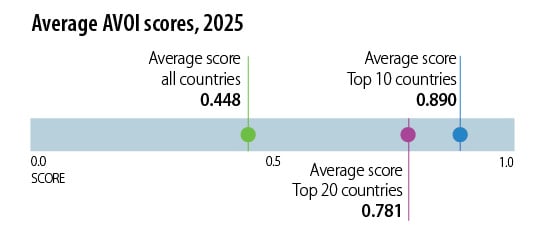
In tracking visa openness across Africa, AVOI has applied a consistent methodology through the past ten years, ensuring a high level of comparability in measuring each country’s visa policy with respect to citizens of every other African country. A full score (1) is allocated to each country-to-country travel scenario where a country removes the requirement for a visa. A slightly lower score (0.8) is given in a visa-on-arrival scenario, to reward countries that allow travellers to visit without the need for pre-travel formalities. Finally, for scenarios where a visa must still be obtained ahead of travel, whether through traditional paper-based processes, or through digital means, no points (0) are allocated.
This year, Rwanda and The Gambia retain their top ranking, while Benin moves to 4th place following the recent introduction of a visa for citizens of five countries1. Kenya becomes the third-most visa-free country, following recent updates to its ETA system which now exempts citizens from 52 African countries from these processes.
During 2025, 20 countries made changes to their visa-policy regime that affected citizens of one or more African country. This resulted in 11 countries scoring higher, and nine lower. Meanwhile, 34 countries made no changes and maintained their overall score. There has been a small increase in the number of travel scenarios that are now visa-free (814, up from 803 in 2024) - accounting for 28.2% of intra-African travel scenarios - reaching their highest ever level.
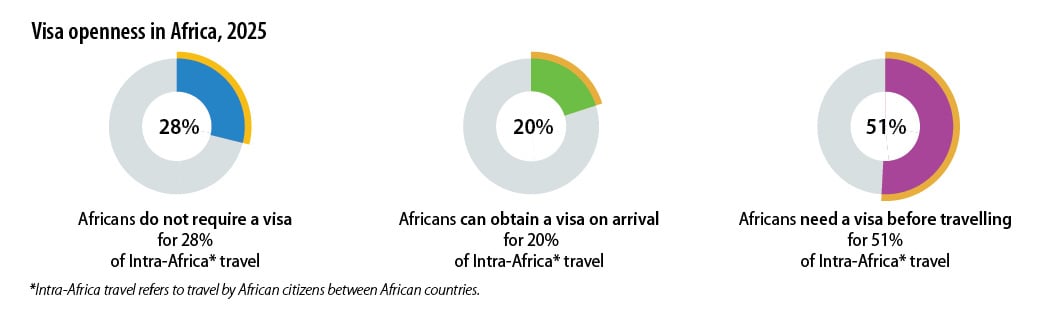
However, there has been a significant increase, from 1,348 in 2024 to 1,463 in 2025, in travel scenarios that are now subject to visa-related formalities ahead of travel. This pushes the ‘visa-required’ metric up, from 47.1% in 2024 to 51.1% in 2025, past the half-way mark and back to a similar level last recorded in 2021. Meanwhile, visa-on-arrival facilities are offered in only 20.4% of all travel scenarios, their lowest level ever, and lower than the 24.8% recorded in 2024.
Closer scrutiny of the data reveals that there has been a significant switch from visa-on-arrival facilities to visa required ahead of travel, rather than towards visa-free status. Four countries -Guinea Bissau, Mauritania, Nigeria, and Somalia - switched from broad visa-on-arrival policies to requiring a visa ahead of travel. This is a step backwards on Africa’s visa openness. However, two of the countries (Guinea-Bissau and Somalia) recently launched an e-Visa portal, taking to 31 the number of countries that offer this. An e-Visa offers more convenience to prospective travellers than a traditional visa. Nonetheless, it is still a visa that is required ahead of travel and is treated as such. This affects a country’s AVOI score, and in some cases results in a significant drop in ranking. Seychelles is a case in point. Its ETA is categorised as an e-Visa (it is required ahead of travel and contains similar information requirements and costs as some other countries’ e-Visas), and this determines the country’s rank in 2025.
Five countries implemented individual policy changes that now require a visa ahead of travel from citizens of affected countries who previously travelled visa-free. This was observed in the case of Algeria (1), Angola (1), Benin (5), Tunisia (1) and Uganda (2), with the number in brackets denoting the countries whose citizens are affected by this change. Compared to the previous two years (2023, 2024), we see a higher number of policy changes in 2025, from visa-free to visa required ahead of travel.
This suggests that countries are resorting to more restrictive visa policies either on an individual basis, or more broadly by switching from a visa-on-arrival to e-Visa facilities. In each of the two scenarios here, obligatory travel authorisation extends the time ahead of travel and affects freedom of movement. Technological advances applied through e-Visas provide countries with a degree of pre-screening that is otherwise not possible with visa-free or visa-on-arrival access. For prospective travellers, this can translate into travel convenience when compared to traditional visa processes ahead of travel. It also offers economic benefits and efficiency gains to countries implementing such systems, but it opens the door to more restrictive approaches to intra-Africa travel that impede rather than ease travel. It remains a requirement that must be complied with ahead of travel.
Visa-free entry
-
49 of 54 countries currently offer visa-free entry privileges to the citizens of at least one other African country, unchanged from the previous year. Of those that do not offer any visa-free access, three are ranked in the top 20 on the AVOI since they offer visa-on-arrival facilities to the citizens of all other African countries.
-
33 of 54 countries offer visa-free travel to at least 10 other countries, while 43 apply this policy to five or more countries.
-
Two countries offer visa-free entry to the citizens of the rest of the continent.
Visas on arrival
- 27 countries offer a visa on arrival to the citizens of at least one other African country (2023: 30). Changes in this metric follow Burkina Faso, Togo and Chad removing visa-on-arrival facilities, with the former two countries adopting an e-visa process.
- 12 countries offer a visa on arrival to the citizens of at least 35 other African countries. The same 12 countries only require a visa ahead of travel from a combined nine African countries.
Visas ahead of travel and e-visas
- 29 countries require a visa ahead of travel from citizens of at least half the countries on the continent.
- 43 countries require the citizens from at least one other country on the continent to obtain a visa ahead of travel.
- 26 countries offer visitors an e-visa. This allows travellers to complete an important component of their travel arrangements online before travelling, adding convenience.
1 Algeria, Gabon, Mauritius, Morocco, Namibia